
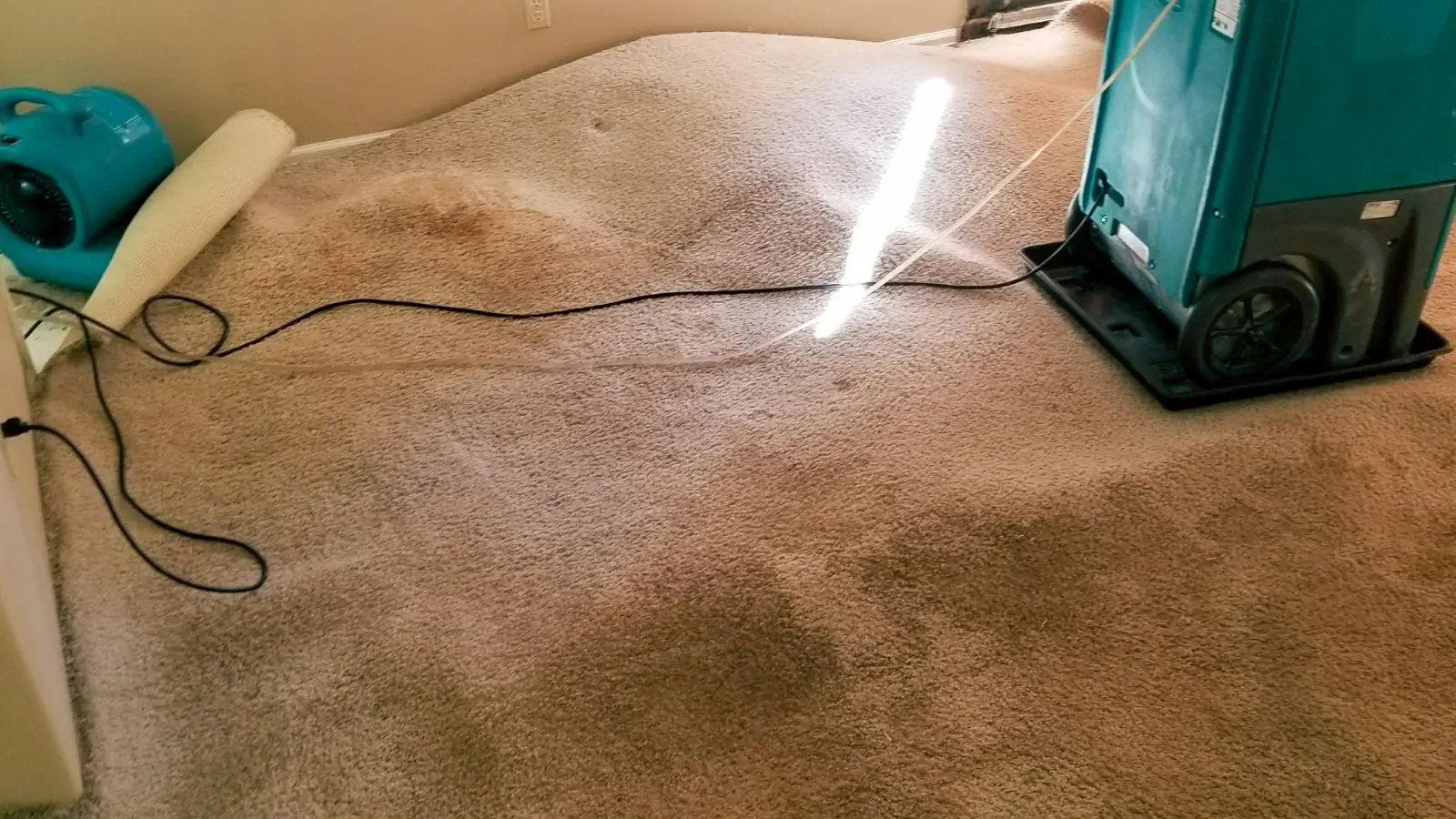
A moisture meter measures how wet a material is, and after water damage it tells you whether a wall, floor or framing member is still holding water that you cannot see. Rosedale, NY homeowners use them after leaks and storms to decide whether to call a professional.
This guide explains the two main types of meter, what the numbers mean and where homeowner readings go wrong. Professional crews use meters together with thermal cameras and humidity logs, as described under structural drying, and readings are only useful when compared to a dry reference.
Pin meters and pinless meters
A pin meter has two small prongs pushed into the material and reads electrical resistance, which falls as moisture rises. It is accurate at a specific point but leaves tiny holes. A pinless meter presses flat against the surface and scans a few tenths of an inch to an inch deep, so it is fast for scanning a wall but is affected by metal, foil and dense backing behind the surface.
Most restoration crews carry both, along with a thermal imaging camera that shows cool wet areas as a picture. None of the tools is a guess. Each gives a number that is only meaningful when compared with a dry spot of the same material.
What to do before you take readings
A few minutes of setup makes readings much more useful.
- Make sure the area is safe and the power is off to any wet outlets.
- Pick a dry area of the same material as your reference.
- Set the meter to the right material mode.
- Mark each reading point so you can repeat it.
- Do not rely on touch alone.
Readings still high?
Call and we check the whole structure.
Readings need a reference, not just a number
Different materials use different scales, so compare like with like.
| Material | How readings are shown | What to compare against |
|---|---|---|
| Wood | Percent moisture content | Unaffected wood in the same room |
| Drywall | Relative scale or percent | An unaffected wall |
| Concrete | Relative scale or specialized test | A known dry slab area |
| Carpet and pad | Relative scale | A dry corner of the room |
Where homeowner readings go wrong
A meter set to the wrong material mode gives a wrong number. A reading over a metal stud, a nail or a pipe can spike. A single reading says little, but a pattern across a wall shows the wet edge. Taking readings at the same points each day shows whether the area is drying.
Surface dryness can be misleading. A floor can feel dry and still read wet an inch deep, and drywall can look fine while insulation behind it is soaked.
What readings mean for the next step
If readings stay high after cleanup, drying is not finished. If they fall steadily toward the dry standard, equipment is working. If they stay high in one spot, there may be an active leak or a trapped wet layer, and a plumber or contractor should check.
Under the ANSI/IICRC S500 standard, professionals set drying goals for each material and record readings until they are met. The EPA advises drying wet materials within 24 to 48 hours to limit mold growth, so do not wait to check.
Mapping a wet area
Start at the visible stain and work outward in a grid, taking readings every foot or so. Mark the edge where readings return to normal with painter's tape or a pencil. That outline is your drying map, and it shows whether wet material is spreading or shrinking from day to day.
Photograph the map with the readings written beside each point. A dated record like this is useful for your own tracking and for an insurer.
Humidity matters too
Surface readings are only part of the picture. Air that holds a lot of moisture slows drying and lets wet materials stay wet. A simple hygrometer shows relative humidity, and dehumidifiers are used to bring it down so that walls and floors can release their water.
Professionals log temperature and humidity along with material readings. At home, watching the humidity number is a cheap way to see whether your drying effort is working.
When to stop drying
Drying is done when each material reaches its goal, not when it feels dry. Keep a short log of dates, locations and readings. When the numbers match your dry reference for a day or two, equipment can come out. Pulling it too soon is a common reason problems return.
Key points to remember
What to remember about readings.
- Compare with a dry reference of the same material.
- Use the right setting for each material.
- Take readings at the same points each day.
- Keep a log until goals are met.
- Do not trust how a surface feels.
- Call a professional if readings stay high.
Moisture notes for Rosedale
The National Weather Service New York office documents tidal flooding on Rosedale streets, such as Hungry Harbor Road and Hook Creek Boulevard, and widespread flooding at Meadowmere during Hurricane Sandy in 2012. After tidal or storm water has entered a lower level, take readings low on the walls and on the floor, and again after a few days, because the water often rises up drywall by wicking.
Our crews serve Rosedale and also Cambria Heights and Lawrence. If readings in your home remain high, see wall and drywall repair for what comes next.
Common questions
Can I buy a moisture meter and do this myself?
Yes, for checking, but readings need a dry reference and some practice. Professional readings combine several tools and a daily log.
What reading means a wall is dry?
It depends on the material and the meter, so compare with an unaffected wall of the same type.
Why does a floor feel dry but read wet?
Moisture can sit below the surface in subfloors and padding.
Does a tidal flood in Rosedale change how I read a wall?
Check low on the wall and again after a few days, since water wicks upward, and ask for professional readings if they stay high.
Need help now?
Our line is open around the clock.